Flood Cube is free, with no paid features and nothing to unlock with
money. A coffee goes to treating my two feline companions, and the
rest to the hosting bill — entirely optional.
Flood Cube is a Daley Games idea he has had in his mind for over 20
years. Feedback is definitely welcome!
Support the game
Flood Cube is free to play and there is nothing for sale. If it has
given you a few good puzzles, you can put something towards the hosting
bill.
🌊 A strategic 3D puzzle: flood every face of the cube with a single colour
in the fewest moves. Tap a colour (or tap the cube itself) to spread it
across connected cells, and solve today's daily challenges before you run
out of moves. 🎯
Have an account? Sign in to save your streak, stats and leaderboard place
across devices.
Login
or
Create Account
or
Welcome to Flood Cube!
Choose your game mode:
🎮 Welcome to Flood Cube!
🎯 Goal
Turn the entire 3D cube into a single color!
🎨 How to Play
Click a color from the palette below the cube
The highlighted square and all connected cells of the same color will flood
to your chosen color
Keep flooding until the entire cube is one color
🧩 Challenge
Complete the puzzle within the move limit to win!
Plan your moves carefully - efficiency is key!
❓ How to Play Flood Cube
🎯 Objective
Fill the entire 3D cube with a single color within the move limit.
🎮 Gameplay
The flood always starts from the highlighted cell (shown
with pulsing border)
Click a color from the palette to flood
All cells connected to the starting cell with the same color will change to
your selected color
Connected cells can wrap around the 3D cube faces
Plan ahead to minimize moves!
🎲 Game Modes
📅 Daily Double: Two daily
challenges (6×6 and 7×7)
🏆 Challenge Cube:
Daily difficult cube with blockers
⚡ Power Mode: Unique puzzle
configurations with powerups.
♾️ Zen - Infinite: Endless random cubes
with no timers. (Signed-in players; open at weekends, or unlock a run with
an optional ad)
💡 Tips
Choose colors that capture the most cells
Rotate the cube to see all faces before making moves
Consider your next 2 moves before changing colours
Progress saves automatically when logged in
Climb the leaderboards by solving in the fewest moves
Flood Cube
☁️
Time:00:00
Moves:--
/ --
Moves Left:
-- /
--
User Status
Status: Anonymous
User ID: --
Freezes: -- • Makeups:
--
Current Game
Time: 00:00
Moves Left: --
Moves Taken: 0
Daily Double Stats
Win %: --
Streak: --
Max Streak: --
Played: --
Freezes: --
Challenge Cube Stats
Streak: --
Week Streaks: --
Max Streak: --
Played: --
Freezes: --
Flood Cube — the 3D flood-fill puzzle game
Flood Cube is a free, browser-based strategy puzzle that takes the classic
flood-it colour game into three dimensions. Instead of filling a flat
grid, you flood the six connected faces of a rotating cube until the whole
surface is one colour — and you have to do it inside a fixed move budget called
Par. Nothing is random once the cube is dealt: no dice, no
timers in the daily modes, no hidden information. Two players given the same
cube and the same Par face exactly the same problem, which is what makes a
shared daily puzzle worth comparing.
You can play immediately as a guest with no sign-up. An optional free account
saves your streak, stats and leaderboard placement across devices. Flood Cube
runs on desktop and mobile browsers and installs as a Progressive Web App, so a
cube you have already loaded stays playable offline.
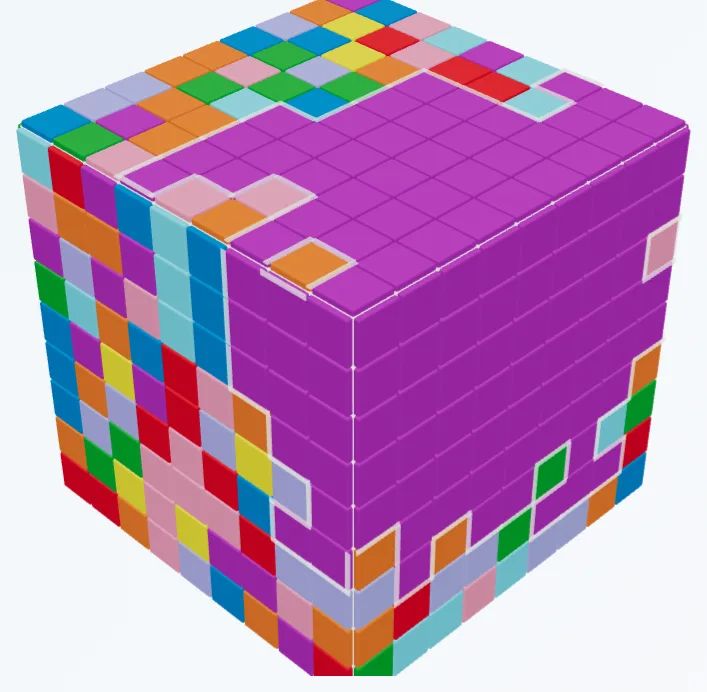
A real cube eighteen moves in. The purple region is a single connected flood
— and it carries on across the edge onto the next face, which is the whole
difference between this and a flat flood-it grid.
How a move actually works
Your flood starts as a single region on the cube's surface. Each move you pick a
colour, and every cell that is orthogonally connected to your current
region and already carries that colour joins the region — then their
same-coloured neighbours join too, and so on. That is a breadth-first fill, and
the important detail on a cube is that connection does not stop at an edge: a
region on the front face continues onto the top or side face across the shared
border. A colour that looks useless from the angle you are viewing can be the
biggest gain on the cube.
A worked example. Say your region touches four red cells on the front face and
two red cells that wrap onto the right face, plus nine blue cells that all sit
on the front face. Blue looks like the bigger move — nine cells against six. But
if those six red cells open a path onto a second face, the red move usually
leaves you with a longer frontier: more distinct colours adjacent to
your region, and therefore more useful choices next turn. Counting cells
captured is the beginner's heuristic. Counting the options the capture opens up
is the one that beats Par.
Two consequences follow, and both are covered with diagrams in the
Strategy Guide: a move that captures nothing is
occasionally correct if it bridges two faces, and the last few moves should be
planned backwards from the colours that remain, not forwards from the biggest
blob. If you want the computer-science side — why flood-fill is a breadth-first
search, and why optimally solving Flood-It is NP-hard — read
how flood-fill works.
What Par means
Par is the move limit, not a par score to beat on average. It is looked up from
a difficulty table keyed on the two things that set a cube's difficulty: the
grid size per face and how many colours are in play. A larger grid needs more
moves; more colours needs many more moves, because each extra colour thins out
the cells any single move can capture. An 8×8 cube with 8 colours has a Par of
43 moves; a 9×9 cube with 9 colours has a Par of 50; the smallest cube in the
game, 5×5 with 5 colours, gets 16. The Challenge Cube is 8×8 with 8 colours on
that same budget of 43 — the blockers make it harder without loosening Par,
which is the point. Sizes outside the table fall back to a regression fit over
the same data.
Practically: run out of moves and the cube is lost, so the whole game is a
budgeting problem. Finishing well under Par is where the leaderboard is won.
No clock and no daily reset — cube after cube, for practice or for
winding down. Needs a free account; open at weekends, or unlock one
run with an optional ad.
Sixteen escalating stages with powerups on the board: Freeze,
Rewind, Starter, Scatter and Shuffle. Open at weekends, or unlock
one run with an optional ad.
Full rules and scoring for each mode are on the
Game Modes page, the controls and the basics are in
How to Play, and
What is Flood Cube? covers where the 3D
variant came from.
Three habits that lower your move count
Rotate before you commit. The cube shows you three faces at
most. Check what your region touches on the faces you cannot currently see —
cross-face captures are the moves people miss.
Prefer the move that leaves more colours adjacent.
Between two captures of similar size, take the one whose new border touches
the widest variety of colours. That is what keeps later moves large.
Leave scattered colours for last. A colour with a few cells
sprinkled over several faces is cheap to clean up once your region is big
and touching everything. Chasing it early costs a move for almost no gain.
Frequently asked questions
Is Flood Cube free to play?
Yes, and there is nothing on sale. The Daily Double and the Challenge Cube are
free for everyone every day, guests included. Power Mode and Infinite Zen are
open at weekends; on weekdays you can unlock a single run by watching an
optional ad. Infinite Zen also needs a free account, because it stores a run you
can come back to.
Do I need an account?
No — you can play immediately as a guest. Signing in simply saves your stats,
streaks and leaderboard placement so they follow you between devices.
How are the puzzles created?
Each cube is procedurally generated from the day's date as a connected colour
layout, so everyone gets the same cube on the same day. The difficulty is set by
the grid size, the number of colours and the Par move budget looked up for that
combination.
What happens if I run out of moves?
The cube is lost and your streak for that mode ends. Daily cubes reset with the
next day, so a bad Tuesday costs you the streak, not your stats.
Does it work offline?
Partly. Flood Cube installs as a Progressive Web App and a cube you have already
loaded keeps working with no connection; syncing your result to the leaderboard
needs you back online.